Intern in Taiwan this summer with OPIT! Applications due February 15th.
As part of its diverse language offerings, the Eurasian Regional Language Program (ERLP) is excited to offer highly-individualized overseas language instruction in three regional varieties of Persian:
Farsi (spoken predominantly in Iran)
Dari (spoken predominantly in Afghanistan)
Tajik (spoken predominantly in Tajikistan and Uzbekistan)
Through intensive language instruction, homestays, cultural activities, and conversation partners, participants enjoy the unparalleled opportunity to immerse themselves daily in a Persian-speaking environment. All Persian language instruction takes place at the American Councils Language Center in Dushanbe, Tajikistan, which hosts expert faculty specialized in teaching Farsi, Dari, and Tajiki alike to provide students with a comprehensive and nuanced understanding of the language and its regional variations.
Programming in multiple languages or dialects (example: Persian + Russian; Farsi + Dari) may be available upon request for semester and academic year participants.

Improve your spoken, written, and overall comprehension of Persian Farsi; you can also opt to add Dari, Tajiki, or Russian language studies.
Engage with local Persian-speaking host families, conversation partners, and teachers on a daily basis.
Experience Dushanbe: where warm hospitality, endless markets, and breathtaking mountain landscapes showcase the heart and beauty of Tajikistan.
Gain academic credit while refining skills in cross-cultural communication.
Join a community of curious, adventurous students ready to explore the world's most mountainous country.

Dushanbe, the capital and largest city of Tajikistan, sits at the heart of Central Asia surrounded by striking mountain ranges and lush valleys. Once a small village known for its Monday bazaars (its name literally means “Monday” in Persian), Dushanbe has grown into a modern city that reflects a deep connection to its Persian, Soviet-era, and contemporary identities. As a cultural center, Dushanbe offers a welcoming environment where visitors can experience both the warmth of Tajik hospitality and the depth of a Persian-speaking culture that bridges Iran, Afghanistan, and Central Asia.
Everyday life in Dushanbe offers full immersion in the variety of Persian known as Tajik, which shares deep linguistic and cultural roots with Farsi and Dari. Living in Dushanbe allows students to experience Persian language all around them, from markets and cafes to media and cultural events, all while gaining insight into Central Asian traditions and history. Outside of just Persian, visitors can hear Russian, Uzbek, and various Pamiri languages spoken around the city—a celebration of the region’s deep history and rich cosmopolitan nature..
The ERLP academic program is designed to improve students' oral, listening, and reading proficiency in Persian. Course work typically includes classes in phonetics, grammar, and conversation as well as composition, oral comprehension, and reading. Language courses also cover topics in literature, history, politics, culture, mass media, and area studies.
Depending on the program site and term, students are either enrolled in small group classes or receive individualized instruction. Students receive approximately 18-20 hours per week of in-class contact hours. All classes are conducted by multilingual expert faculty who have extensive experience teaching foreign students in any variety of Persian.
All participants on the Farsi and Dari academic tracks will also receive two hours per week of Tajik instruction to familiarize themselves with the Cyrillic script and the language as spoken colloquially in Dushanbe. Programming in multiple languages or dialects (example: Persian + Russian; Farsi + Dari) may be available upon request for semester and academic year participants.
Participants receive academic credit through Bryn Mawr College, an institutional member of American Councils.
Summer: 8 undergraduate or 10 graduate credit hours
Semester: 16 undergraduate or 15 graduate credit hours
Academic Year: 32 undergraduate or 30 graduate credit hours
EURA 320 | Advanced Conversation: Persian | 1 Unit/4 Credits
EURA 330 | Advanced Grammar: Persian | 1 Unit/4 Credits
EURA 350 | Advanced Conversation: Persian | 1.5 Unit/6 Credits
EURA 360 | Advanced Grammar: Persian | 1.5 Unit/6 Credits
EURA 314 | Readings in Eurasian History and Culture | 1 Unit/4 Credits
EURA 352 | Advanced Conversation: Persian | 1.5 Unit/6 Credits
EURA 362 | Advanced Grammar: Persian | 1.5 Unit/6 Credits
EURA 315 | Readings in Eurasian History and Culture | 1 Unit/4 Credits
EURA 515 | Advanced Conversation: Persian | 1 Unit/5 Credits
EURA 525 | Advanced Grammar: Persian | 1 Unit/5 Credits
EURA 550 | Advanced Conversation: Persian | 1 Unit/5 Credits
EURA 560 | Advanced Grammar: Persian | 1 Unit/5 Credits
EURA 513 | Readings in Eurasian History and Culture | 1 Unit/5 Credits
EURA 552 | Advanced Conversation: Persian | 1 Unit/5 Credits
EURA 562 | Advanced Grammar: Persian | 1 Unit/5 Credits
EURA 514 | Readings in Eurasian History and Culture | 1 Unit/5 Credits

Program participants live with local Tajik Persian-speaking host families. Living with a host family provides valuable cultural experience to complement the academic program. Host families expose participants to authentic, everyday life in Tajikistan while also providing a supportive environment for students to practice their growing language skills. While staying with a host family, participants are provided with a private room, two meals per day, and keys to the apartment or house. All host families are screened, selected, and monitored by American Councils home-stay coordinators and resident directors.
As part of the program, participants engage in a number of excursions and cultural activities. Activities outside the classroom are designed to give participants a deeper understanding of life, culture, and history in Tajikistan. While excursions and activities vary from year to year and by location, past participants have enjoyed excursions to Hissor Fortress, Kokhi Navruz, and Iskanderkul Lake, as well as cultural activities such as pottery classes, music classes, and traditional Tajik feasts.
Once per term, an extended regional field studies trip is organized to a different city or region of Tajikistan, such as Panjakent - a city in western Tajikistan known for its ancient history and stunning Seven Lakes (Haft-Kul) - or Khujand - the second-largest city of Tajikistan once world famous for its strategic position along the Silk Road.

Explore the history of Tajikistan and Central Asia, from its Bronze Age archaeology to its independence from the Soviet Union and beyond.

Experience daily traditions with bazaars, performances, and authentic community interactions.

Tour local museums to capture the many facets of Tajikistan’s history and culture.

Travel beyond Dushanbe to discover Tajikistan’s beautiful mountains, valleys, and cities.

To aid cultural integration and support academic learning, participants have the opportunity to meet with conversation partners for two hours per week. Conversation partners introduce participants to local people, accompany participants on sightseeing tours, organize cultural activities (cinema, museum, etc.), and provide students with academic support. The conversation partners are expected to speak only the target language to provide extra language immersion.

The American Councils Language Center in Dushanbe, Tajikistan, is conveniently located on Rudaki Avenue, the vibrant heart and main artery of the city. Our classrooms are within a 15-minute walk of many city attractions, making it easy for students to immerse themselves in the local culture. The center offers expert language instruction in all three major Persian dialects, delivered by teachers with years of experience. Whether you’re looking to build conversational fluency, deepen your understanding of regional nuances, or explore Tajikistan’s rich linguistic heritage, our language center provides a supportive and professional environment to achieve your goals.
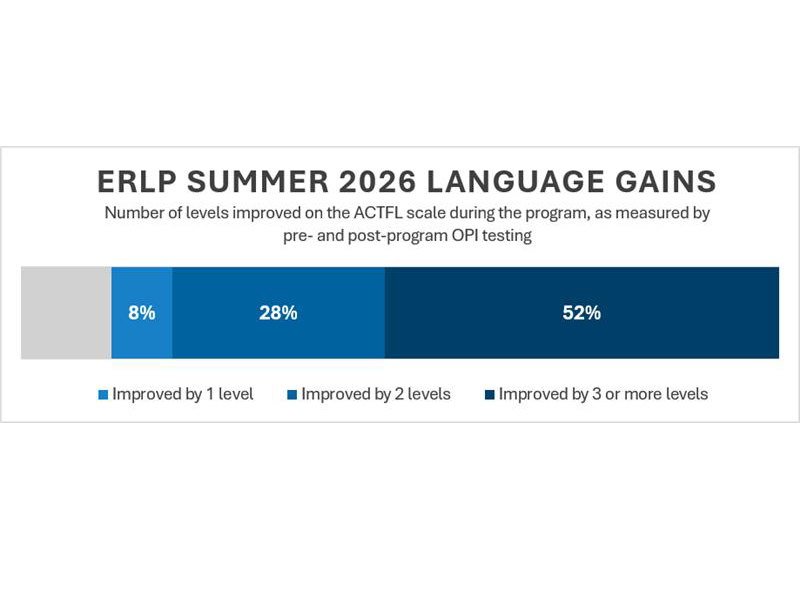
American Councils has decades of experience delivering intensive language programs designed around measurable proficiency growth. Through rigorous instruction, individualized learning, and opportunities to use the language beyond the classroom, students build skills they can use in academic, professional, and everyday settings.
80% of ERLP Summer 2026 participants improved by two or more ACTFL proficiency levels.
Multiple sources of funding are available to support participants in paying for programs abroad. Participants are encouraged to apply for private scholarships, federal aid and grants, college/university scholarships, and American Councils fellowships and scholarships.
Summer participants attend a two-day orientation program on site immediately upon arrival in country (where they are met at the airport by AC Staff). All semester participants must attend a mandatory pre-departure orientation before the program begins. Sessions cover health and safety, academic culture, host-family life, culture shock, and strategies for maximizing language learning. Students meet resident directors, peers, and alumni, with lodging and meals provided.
While abroad, participants receive 24/7 emergency support from in-country American Councils staff, which includes both local professionals and U.S. expatriates. Local offices coordinate academic placements, cultural excursions, housing, and medical assistance. The AC Study Abroad Team in Washington, D.C. maintains regular contact with overseas staff, partner universities, and families to ensure ongoing support and program quality.
Participants are covered by Cultural Insurance Services International (CISI) for the full duration of the program. The policy provides up to $250,000 in medical coverage per accident or illness, as well as complete coverage for emergency medical evacuation. Enrollment is automatic and included in program costs.
American Councils provides visa support for participants for the duration of the program in the host country, if applicable. Students are responsible for obtaining any additional visas required by their travel plans. Visa instructions and forms are provided after acceptance.