Summer 2027 Applications are now open!
Spring 2027 Application Deadline: October 15th.
BLI is back starting Spring 2027! Apply Now!

A Smart Investment in Your Future
Studying abroad is more than an academic experience: it’s a proven way to build career-ready skills, increase earning potential, and stand out in today’s global job market.
Research shows that students who study abroad earn over $4,000 more1 in their first year and see measurable gains in long-term earnings, making it a smart investment in both education and future career success (The Forum on Education Abroad, 2025).
job openings require skills students acquire while studying abroad.2
Earned more in the first year after study abroad.1
Additional salary advantage for bilingual professionals.3
More job opportunities with language skills.4
of employers say their language demand will increase in the next 5 years.4
the number of remote job listings for workers with bilingual skills since 2010.4
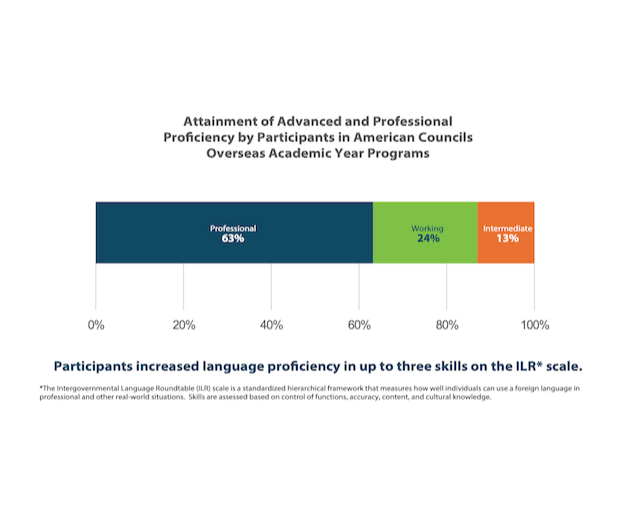
The U.S. faces a critical shortage of advanced speakers of key languages, which are essential to national security and global engagement.
American Councils helps close this gap in critical languages: 63% of A.C. students reach professional-level proficiency after a year abroad, and 97% gain at least one proficiency level in certified test scores during single-term immersion programs. Alumni strongly confirm the lasting importance of these gains, with 73% of former A.C. program participants reporting they use their language skills in their careers.
By focusing on critical languages, our programs give students a clear advantage in a competitive, global workforce.
Language skills are more than an academic asset, they give students a measurable edge in today’s job market.
Earn more: Bilingual professionals earn 5–20% higher salaries on average3
Access more opportunities: Language skills can create up to 35% more job opportunities, especially in globally connected fields4
Stand out to employers: 9 out of 10 employers rely on multilingual employees, and demand continues to grow5
Bring real value to companies: Language barriers cost U.S. businesses an estimated $2 billion annually, increasing the need for employees who can communicate across cultures4
Study abroad accelerates this advantage. Through full immersion, students build practical language skills, cultural fluency, and real-world confidence, gaining qualities that help them stand out in internships, job searches, and long-term careers.
Study abroad is more than an experience, 44% of employers say they are much more likely to hire candidates with meaningful global learning experiences6. Students who study abroad demonstrate qualities that hiring managers look for, including:
The ability to adapt to new environments
Strong communication across cultures
Problem-solving and independence in unfamiliar settings
Real-world experience navigating global perspectives
These are not just personal growth outcomes; they are transferable skills that translate directly into a hiring advantage7.

With American Councils, your experience doesn’t stop when you return home.
We help you turn what you’ve learned abroad into a clear, professional advantage through:
Resume-building workshops
Guidance on how to articulate your study abroad experience during interviews with employers
Support in identifying and communicating your transferable skills
This ensures that your time abroad is not just meaningful but marketable.
The Forum on Education Abroad. (2025). Study abroad outcomes and career impact report.
NAFSA: Association of International Educators. (2020). Independent research measuring the impact of study abroad.
Liwiński, J. (2019). The wage premium from foreign language skills. Empirica, 46(4), 691–711.
New American Economy. (2017). Not lost in translation: The growing importance of foreign language skills in the U.S. job market.
American Council on the Teaching of Foreign Languages (ACTFL). (2019). Making languages our business: Addressing foreign language demand among U.S. employers (Executive summary).
Finley, A. (2021). How college contributes to workforce success: Employer views on what matters most. Association of American Colleges and Universities.
American Council on the Teaching of Foreign Languages (ACTFL). (2013). Employability skills and world languages.
