

When people think about studying a foreign language, they usually imagine classrooms, managing vocabulary lists, and grammar exercises. While those are certainly part of my summer study of Romanian here in Moldova, I’ve quickly realized that some of the most memorable lessons happen outside of the classroom. Every weekend, our program here in Chisinau takes us on cultural excursions across the country, giving us the opportunity to learn more about Moldova’s history, rich traditions, landscapes, and communities that make this country unique. One of my favorite excursions so far took us to the Curchi Monastery and Old Orhei, where history, religion, and everyday life all came together in ways that are difficult to appreciate from pictures alone.
The entrance to the Curchi Monastery in Vatici, Orhei District, around a forty-minute trip by car outside Chisinau, was our first stop on our weekend cultural excursion through Orhei. The site is an Eastern Orthodox monastery that was opened during the 18th century. In the second half of the 20th century, the monastery was used as a psychiatric hospital, but was reopened as a monastery in the early 2000s.
Today, the monastery is highly renowned for its herbal teas sold in the attached shop, which are packaged from what is gathered in the forests and hills surrounding the monastery. While I haven’t had the chance to try their tea yet myself, our program director and guide for this excursion said she makes a point of buying some whenever she comes here.
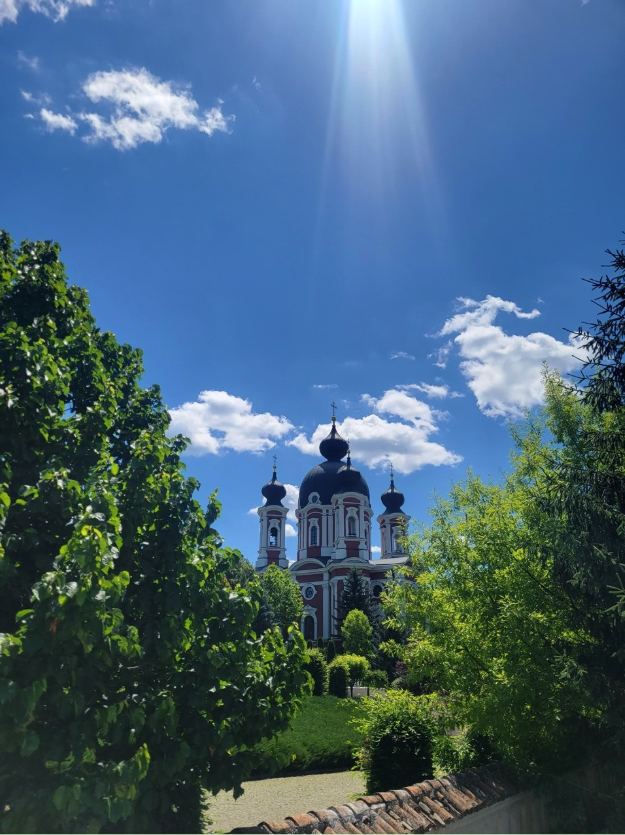
Through the entrance into the monastery complex and along a beautifully decorated garden walkway, we approached the Church of the Nativity of the Holy Mary, also known as the Summer Church.
This church is the largest of the churches within the monastery complex and is where the main services are held throughout the warmer months. It is ornately decorated with religious iconography.
As we arrived on a Sunday afternoon, the area itself was bustling with visitors, both locals and tourists.
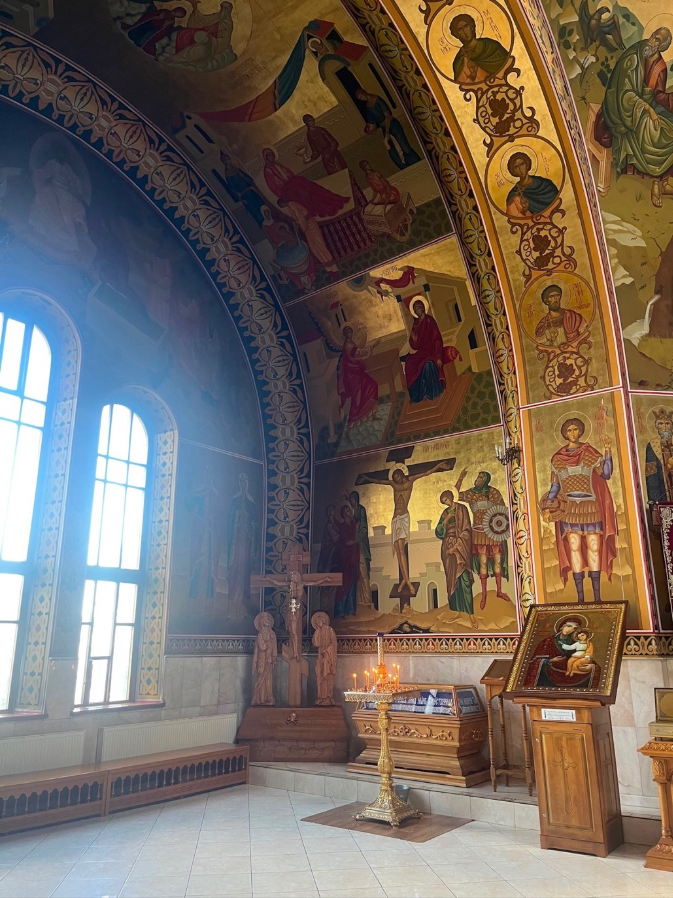
Entering the church, we were immediately met with the scent of incense in the air, which I assume was a remnant of the morning’s service. The building was entirely covered by icons; every available space on the walls depicts a specific religious event or story. Beyond the beautiful design, we were able to see many of the artifacts that the church had out on display in front of its altar.
After visiting several of the churches within the monastery, we visited the shop where several of us purchased the previously mentioned tea, admired some of the icons which were for sale, and prepared for another drive to Old Orhei where we would spend the rest of our day.
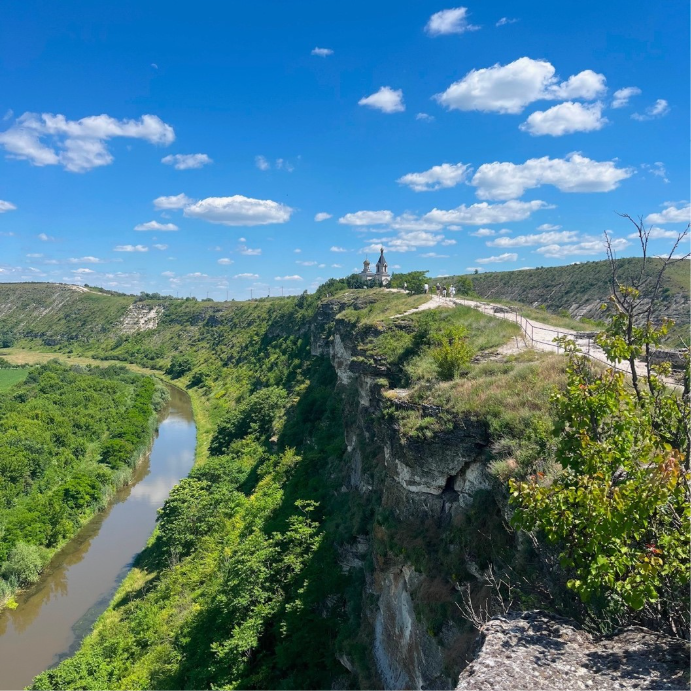
Old Orhei, or Orheiul Vechi, is both the site of an ancient city and a current (though not modern) monastery. Over the centuries, many different peoples have settled in this naturally defensible landscape along the Răut River. The earliest traces of people living here date to, at the earliest, the 6th century BCE.
Before arriving, I had seen photos of this place, but standing on the cliffs overlooking the valley made me appreciate why it is considered one of Moldova’s most iconic historical sites.
Along the path up the cliffside, we stopped at an old stone cross overlooking the river and farmlands below. This cross was described to us as a wishing stone, and that if you placed your hand on the stone and thought of your wish, and then walked around the stone three times, your wish would come true. Of course, everyone in our group decided to give it a try. But we can’t tell you if it came true or not, or our wishes will be reversed.
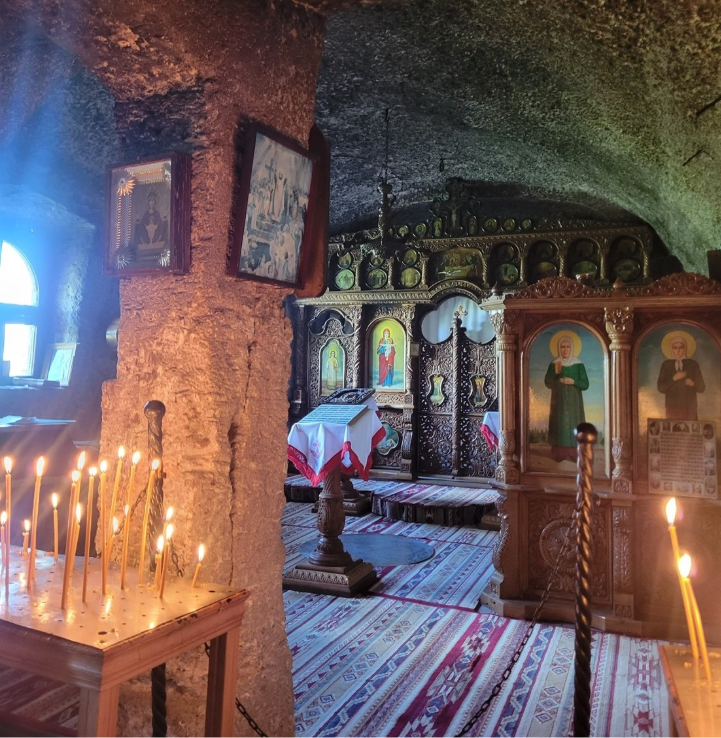
Carved into the cliffside is an old monastery that is maintained and operated by a single monk who lives there and sleeps on a simple cot in the same room. Every day, the monk invites visitors to come and see the cliffside church, and people will often buy icons, candles, or just give donations. In the past, there used to be more monks who lived here, and we were able to climb into the cells where they all used to sleep, pray, and eat. Some of the residents of the adjacent village, Butuceni, keep an eye on the monk, making sure he is healthy and providing him with water and simple foods.
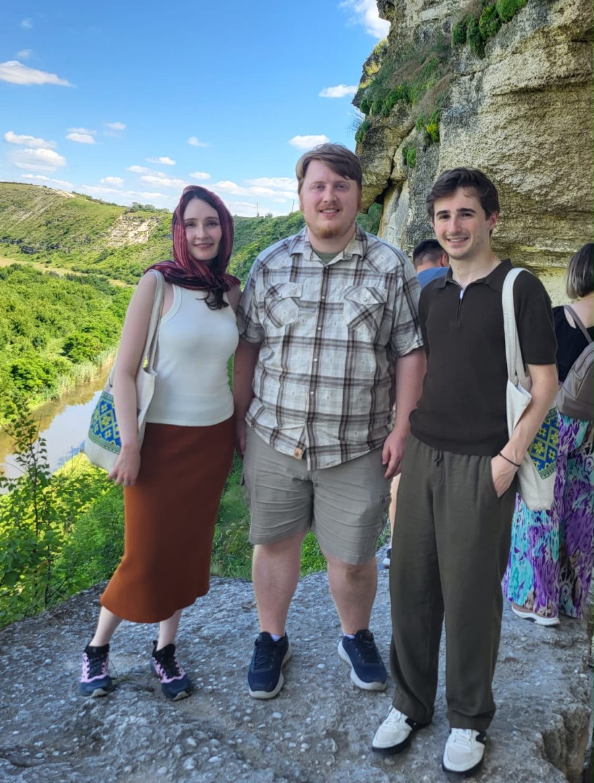
Me (on the right) with the two other students here who are studying in Chisinau with the Eurasian Regional Language Program. Here, we are standing out on an outcropping which extends out from the cliffside monastery. There was a wonderful view here, overlooking the nearby river, the farmlands, and fishermen out on their piers. In the walls, visitors would leave behind a few lei coins (the Moldovan currency) stuck into the soft rock for good luck.
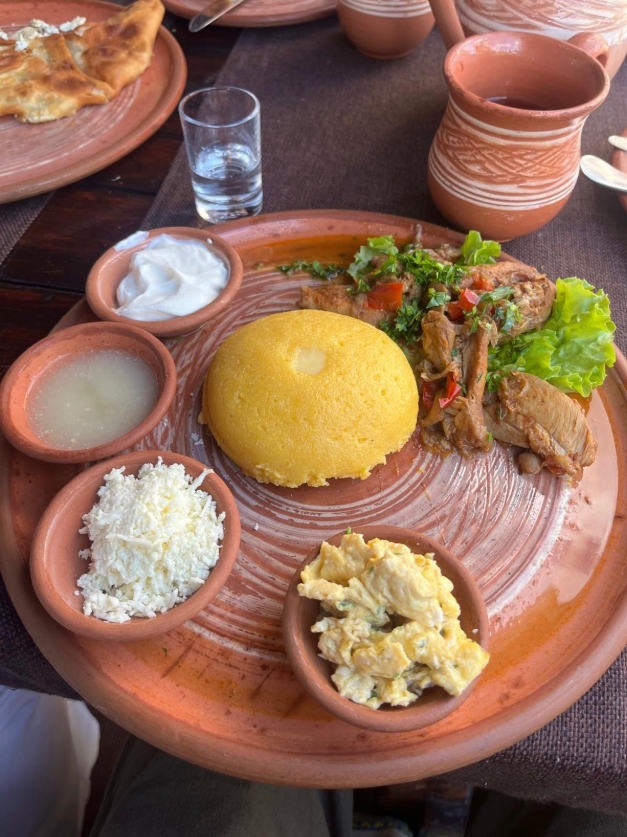
And then our last stop for the day was for dinner in the neighboring village of Butuceni. Here I was able to order some delicious traditional Moldovan cuisine. I had mămăligă with chicken, eggs, cheese, oil, and a type of sour cream called smântână. To drink, we split a pitcher of compot, a traditional non-alcoholic Eastern European drink made by boiling fruits with sugar and water. It was also a nice opportunity to practice some Romanian outside the classroom while ordering dinner.
As someone who has never been to Moldova before this summer, this excursion gave me a much deeper appreciation for the country beyond Chisinau. Seeing centuries-old monasteries carved into cliffs, walking through landscapes that have been inhabited for thousands of years, and then ending the day with traditional Moldovan food helped put everything I’ve been learning in class into a bigger picture. Experiences like these remind me that studying abroad, while about learning a language, is much more than just that. It is a unique opportunity to begin to understand the people, history, and traditions that give that language meaning. I’m looking forward to discovering even more of Moldova over the rest of the program and continuing to connect what I learn in the classroom with experiences like this one.