
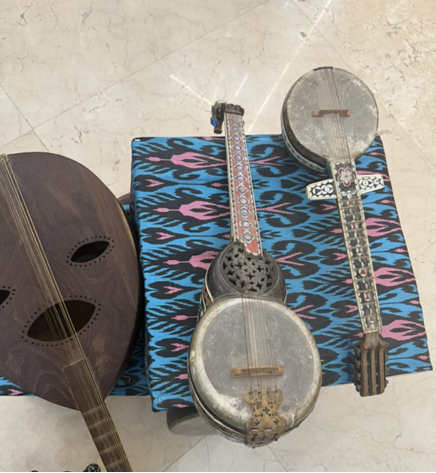
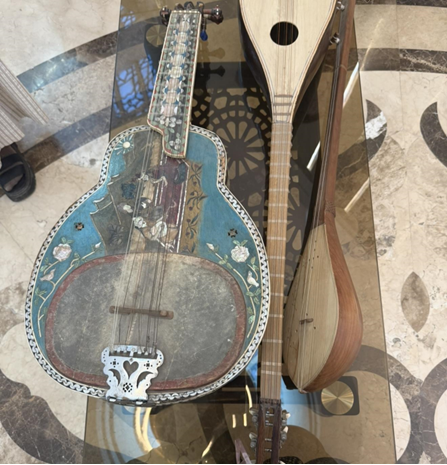
An assortment of classical hand-crafted Central Asian instruments on display at the museum within the Istiklol Tower / Monument in Dushanbe.
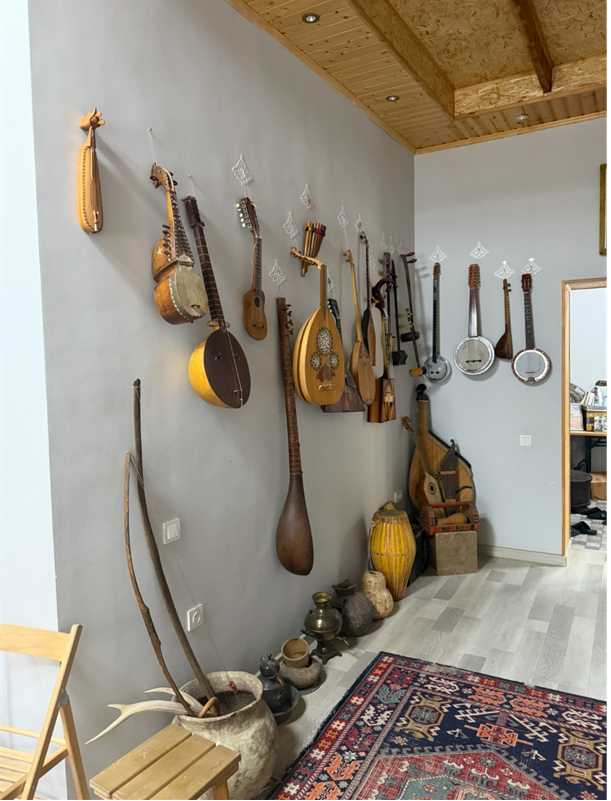
A snippet of the various instruments on display at the Gurminj Museum of Musical Instruments in Dushanbe, home to over 100 classical instruments found throughout Central Asia, India, Iran and beyond.
My brief time in Dushanbe so far has been defined by a combination of advanced Persian language coursework and daily musical training at a renowned music museum and school. Together, they form a single project of deep personal significance: to familiarize myself with a set of musical Central Asian and Iranic traditions often unknown by the rest of the world. Mornings are devoted in Farsi and Tajiki class, pouring through grammar, idiom, traditional folklore and regional cinema; afternoons and evenings are claimed by the potent beat of the daf – a hand drum whose variations can be found throughout Iran, Kurdistan, Afghanistan, and Central Asia.
Somehow I have managed to land a unique opportunity to be immersed in instrumental and vocal instruction, dance training and am getting to work with a renowned local ensemble and members of the Dushanbe Philharmonic. My teachers, hailing from Tajikistan’s Bartang Valley in the Western Pamir / Gorno-Badakhshan mountain range, are ethnic Pamirians, a minority group spread across Tajikistan, China, Afghanistan and Pakistan. Pamirians speak a number of semi-mutually and non-mutually intelligible Eastern Iranic languages, presumably close to Pashto and comprise roughly 300,000 people or so. Though their numbers may be small, the Pamirians are mighty: after all, these are communities whose stories include fleeing from greater Iran into the Pamirs in the 7th century and surviving the invading armies of Alexander the Great. It is an understatement to say that it is merely a gift to use my language skills to be able to learn and have the permission to document the musical traditions from a very small community with a longstanding civilization. Given that this community is now acutely experiencing and enduring, for example, the adverse effects of extreme climate change that demands departure from their traditional homeland – it is indeed both a great stroke of luck and a tremendous honor to be able to spend time with them in this way.
At the music school, instruction is structured and technical. During my daily lessons, my teachers move fluidly among instruments — rubab, tanbur, dutar, ghijak, nay, and doira — using each to help me understand different aspects of their tones as well as the mechanics of playing in an ensemble. Even so, these classes have been anything but impersonal. My instructors have welcomed me with open arms; when not focusing on tone clarity, controlled resonance, and endurance on the drums, we spend our time drinking tea, translating and transcribing songs, and sharing musical interests. The musicians are infinitely curious about folk and contemporary music from around the world, and as a mixed-culture American who loves music from Cuba to Congo, from France to Balochistan, I am more than happy to oblige in providing them with music they can learn from other musical traditions that I also love. We’re now currently discussing the merits of American country and bluegrass; it seems they are seriously contemplating my suggestion that Elvis’ Devil in Disguise on rubab might tickle the visitors that every so often drop by to learn more about local music and jive with the comedic traditions found within Pamirian music. Our daily jam sessions are overflowing with joy.
Still, Pamirian music is serious business, marked by just as much cheekiness as melancholy. My teachers are currently attempting to write playful tunes in English to the violin-like ghijak in order to effectively translate the more humorous Pamirian songs. But in Tajikistan, Pamirians are most famed for their transcendent music – music as lonely and emotionally stirring as the magnificent Pamir Highway itself. Both Pamirian and Persianate music, undoubtedly inspired by the age-old traditions of Sufi whirling and devotionals, aim to entrance, their circular repetitions intending to stir the listeners to dance. Tajik and Pamirian songs in particular are notably often devised using a call and response structure – these songs are meant to be performed with community. The wail of the lead singer as he strums his solemn ballad, followed by the other teachers’ dizzying cries – can just as easily move one to dance as it can break one’s heart.
I’ve just completed some basic lessons in falak, the Pamirian highland tradition often translated as “fate.” The falak genre is deeply tied to the emotional and cultural expressions of the Pamiri people. It’s typically characterized by its often mournful tone. The songs of falak often reflect themes of longing, separation, love, and grief. What makes falak music so unique is its ability to evoke the sensation of experiencing destiny’s weight and the force of time’s eternal passage on one’s life. The lyrics, somber and reflective, contend with real-life struggles such as personal tragedy, life’s sometimes arbitrary cruelty, and the complexities of love.
Music generally is defined by the use of traditional instruments like the dombra (a two-stringed instrument) and kamancheh (a bowed instrument commonly found in Iranic musical traditions). My focus has begun to shift from basic mapping of the repertoire to deeper comprehension and analysis: mapping rhythmic cycles across falak, maddah (spiritual devotionals, in the Pamirian case, praises in reference to Ismailism, the branch of Shia Islam practiced by Pamirian communities), and classical muqam structures.
In broad strokes, Central Asian music is typically defined by its use of muqam, the highly intricate and traditional system of music found in Central Asian cultures, particularly in the Pamirian, Uzbek, and Tajik regions. What makes muqam unique is that it encompasses all the different notes—including microtones that lie between the notes of Western music. These small intervals create a rich, nuanced soundscape that gives muqam its distinctive depth and ability to skillfully convey multiple emotions. Consider the case of Tajik wedding songs, which at once describe both the grief a Tajik mother experiences watching a beloved son growing older and the joy at his arrival at a personal milestone of beginning to build a family.
Afarin, Nazanin, janaana, lab shirin, I repeat the lead singer’s refrain – "Bravo, my beloved Nazanin. My soulmate, with sweet lips." I watch my drum instructor’s fingers skillfully dance along the face of the doira drum, with every stroke releasing a cascade of twinkling chimes from the hundred or so small metal rings tightly stacked together concentrically within the drum’s inner frame, I wonder how much I’ll be able to document this while I am here. Light on his feet, he is able to at once spin his body, swinging the drum up and down, left to right, adeptly pivoting on his toes, all while sustaining a steady pace on the drum, keeping the essence of the song alive. I’m hoping I have just enough time here to at least master the basics.